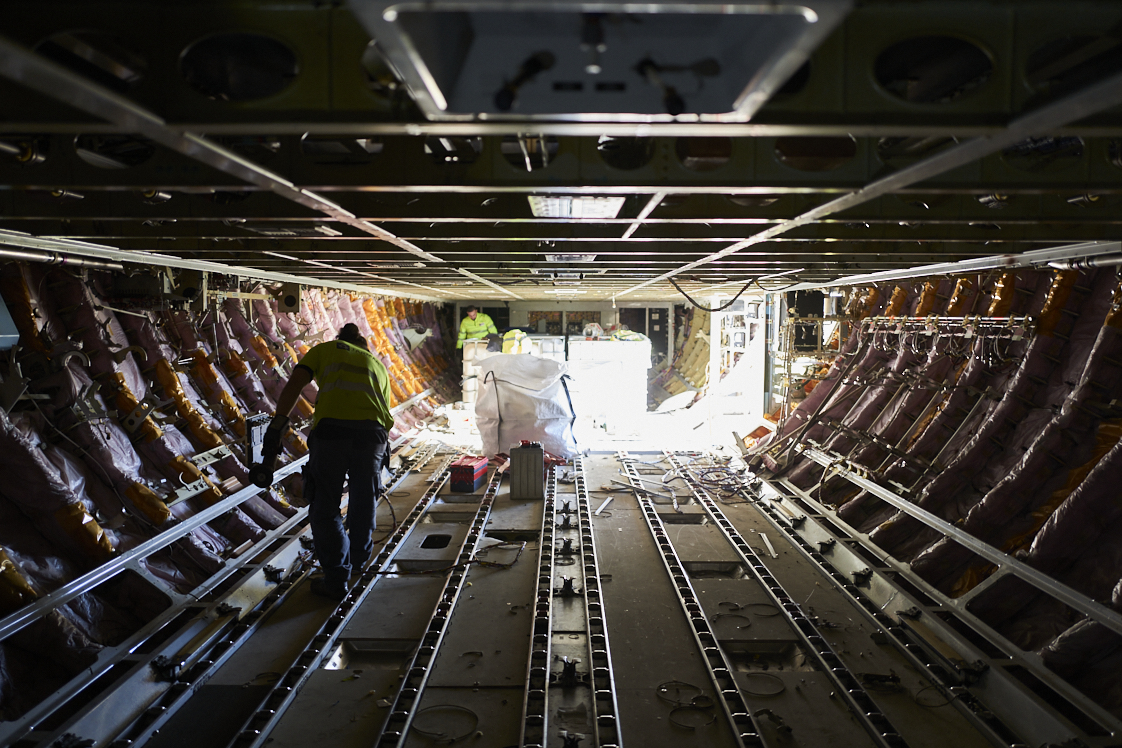
A few words are taboo in TARMAC Aerosave: scrap metal, breaker’s yard and graveyard. Scrap metal, because materials that compose complex machines such as aeronef are extremely diversified. Breaker’s yard, indeed, here at TARMAC Aerosave, we don’t wreck or destroy. No, we dismantle, we cut up , we take apart, we sort. In a word, we recycle. 92% of the aircraft’s mass is recycled. Graveyard, as, at TARMAC Aerosave, aircraft don’t die, they reincarnate.
A dismantling complete take approximately 6 weeks. When it arrives at his arrival at TARMAC Aerosave, the aircraft still belongs to its owner, whois usually a lessor or a bank, as only a part of the planes in the fleet belong to the airline operating them. The owner draws up a list of equipment’s they wish to recover, items that have value on the second-hand market: engines, landing gear, avionics. TARMAC Aerosave is responsible for dismantling or packing these items, then either storing them in their warehouse, or returning them to the owner.
The aircraft then transitions from being an aeroplane to becoming waste. It is now the property of TARMAC Aerosave. The complex recycling process, developed by TARMAC Aerosave since its creation in 2007, is launched. The entire structure, down to the smallest rivet, is dismantled. We sort by material and by part: fluids, plastics, metals, fabrics, cables. The parts are then sent to the recycling chain.
When only the airframe and fuselage remain, the latter is selected: first the wings, then the fuselage in sections, using a cutting frame, also unique in the world, designed and developed by TARMAC Aerosave. This is a cold cut, which avoids any risk of fire, using a diamond-tipped cable. During cutting, the fuselage is sprayed with water to prevent dust from falling directly onto the ground and being blown away. Finally, the sections obtained are reduced to small pieces and recycled. This is a far cry from the image of excavators violently tearing apart the fuselage without distinguishing between metal parts, seat blocks or electrical systems.
To go further, TARMAC Aerosave is working on research project with his partner Suez, to recycle the composite materials. Besides, she has created, in 2025, the brand TARMAC Legacy, in order to sell to enthusiastic individuals and professionals, a collection of created objects from pieces non-recycled.
Beyond recycling, The aircraft’s life cycle continues with upcycling.